A Complex Heart Defect, Five Surgeries and One Remarkable Little Girl
Patient Stories


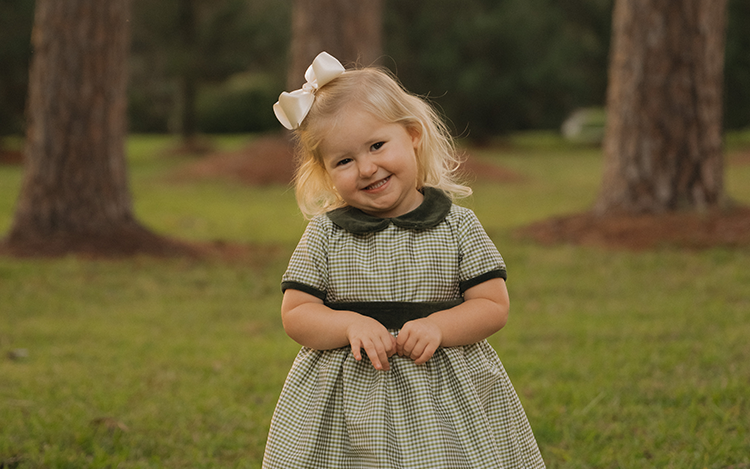
When Natalie and Robert learned at their 20-week anatomy scan that their daughter had a serious congenital heart defect, their world changed in an instant.
The Baton Rouge couple suddenly found themselves facing difficult decisions and an uncertain future for their unborn child. What began as a diagnosis of transposition of the great arteries (TGA) would ultimately reveal even more complexities in her heart.
Today, Audrey is a thriving 2-year-old who runs, jumps and keeps her parents on their toes. Her journey to get there required multiple surgeries, months in the hospital and the expertise of the team at Texas Children’s Hospital.
After receiving Audrey’s diagnosis, Natalie and Robert quickly began researching their options.
“We were willing to go anywhere for the best,” said Natalie, who’s a nurse herself.
Their obstetrician immediately recommended Texas Children’s. As they learned more about the hospital’s nationally recognized Heart Center, the decision became clear.
“We saw that Texas Children’s was ranked No. 1 in pediatric cardiology and heart surgery, and it was drivable for us,” said Natalie. “It was a no-brainer.”
At 26 weeks, the family traveled to Texas Children’s for a fetal echocardiogram, a specialized ultrasound used to evaluate a baby’s heart before birth. The evaluation revealed additional abnormalities that made Audrey’s condition more complicated than originally thought.
At the time, doctors believed she might ultimately need a series of operations known as single-ventricle palliation, a treatment pathway used when the heart cannot support normal two-ventricle circulation.
Then, around 30 weeks into the pregnancy, the family met Betul Yilmaz Furtun, MD, medical director of Fetal Cardiology at Texas Children’s.
“There was a possibility she could have a full repair, but they wanted to wait until after birth to know for sure,” said Natalie.
“As fetal cardiologists, we often meet families at one of the most vulnerable moments of their lives, when they are first learning about their baby's complex congenital heart disease. We never take the trust families place in us for granted,” Dr. Yilmaz said. “Our goal is to provide compassionate guidance, prepare them for what lies ahead, and offer the most accurate understanding of possible outcomes while acknowledging the uncertainties that can accompany each unique journey.”
Audrey was born at Texas Children’s on Aug. 9, 2023. Shortly after birth, her care team performed additional imaging and reviewed her case during a multidisciplinary conference. The findings suggested that a two-ventricle repair might be possible.
For the family, one of the most reassuring parts of their experience was the confidence and experience of the team caring for Audrey.
“None of the clinicians acted like this was the most complex thing they’d ever seen,” said Natalie. “That gave us confidence they had seen cases like this before and knew how to handle it.”
Robert, who’s a physician, said the depth of expertise stood out immediately.
“It’s not like there’s one ECMO specialist — there’s a dozen,” said Robert. “It’s really a full team of expertise with every service possible.”
At 6 days old, Audrey underwent surgery to correct her TGA. During the procedure, surgeons discovered an unexpected coronary artery abnormality that prevented the planned repair from being completed successfully. Audrey became critically ill and required extracorporeal membrane oxygenation, or ECMO, a form of life support that temporarily takes over the work of the heart and lungs.
About a month later, Audrey required another ECMO run and a second attempt at the surgery. This time, the outcome was different. The surgery successfully improved her circulation and stabilized her condition. After spending 110 days in the hospital, Audrey was finally able to go home.
“As a nurse, the nursing ratios were phenomenal,” said Natalie. “When she was on ECMO, there were three nurses caring for her.”
Even after Audrey’s initial recovery, her heart journey was not over.
When she was about 1 year old, doctors planned another surgery. The expectation was that she would continue down the single-ventricle pathway and undergo a Glenn procedure, a surgery often used when the heart can’t function with two fully working ventricles.
But once again, Audrey surprised everyone.
While in the operating room, surgeons determined that her right ventricle could support normal circulation. Instead of moving forward with the planned single-ventricle surgery, they were able to complete a repair that allowed Audrey to function with two ventricles. For Audrey's family, it was a turning point they once weren't sure would be possible.
For children facing complex heart defects, achieving a two-ventricle circulation can offer important long-term advantages when it’s safely possible.
“At Texas Children’s Heart Center, we believe in getting our patients the surgery that would serve them best not just for the first year, but for the next 70 to 80 years. Audrey is a great example of that,” Rocky Tsang, MD, medical director of the Single Ventricle Program. “We weren’t sure if her heart could be repaired as a two-ventricle heart, but with careful planning and precise execution, we were able to achieve that for her.”
At 2 years old, Audrey has already undergone five open-heart surgeries and has a pacemaker. Yet most people would never guess everything she’s overcome.
“She’s so smart and full of personality and we are unbelievably proud of her,” said Natalie.
The family continues to travel from Louisiana to Texas Children’s for follow-up care. Audrey sees Dr. Tsang every 4 to 6 months, and when a pacemaker lead failed, the family was flown back to Texas for urgent treatment.
Even from 400 miles away, the family says they’ve never felt alone.
“The way they continue to monitor and follow up in any way necessary, we felt they were with us every step of the way,” said Robert.
For families facing a complex congenital heart diagnosis, that combination of expertise, collaboration and long-term support made all the difference for Audrey — and continues to shape her future today.
Learn more about our Heart Center team, the nation's No. 1 pediatric heart center.