
min. read
At 26 weeks pregnant, Sonya Bly thought she was experiencing a normal part of late pregnancy —swelling, discomfort, and the kind of changes many expectant mothers have as they near their last trimester. But after returning home from an international trip, something didn’t feel right.
A quick check of her blood pressure changed everything. Within hours, Sonya’s concerns went from routine to a full-blown emergency.
When she needed a higher level of support than her local urgent care and community hospital could provide, the Texas Children’s Kangaroo Crew transport team was called. Soon, Sonya was surrounded by a growing team of specialists and was suddenly facing the unthinkable: the possibility of delivering her daughter months too soon.
“They told me if my blood pressure didn’t come down, I might deliver early,” she recalled. “I kept thinking — it’s too early, I still have so much time left.”
Doctors worked urgently to stabilize Sonya, buying precious time. Each day mattered. When Sonya reached 27 weeks, the outlook for her baby improved dramatically, but the relief was short-lived. Just days later, her care team shared difficult news: her baby was in distress, and delivery could not wait.
Within the hour, Ayva was born, weighing only two pounds.
A Fragile Beginning
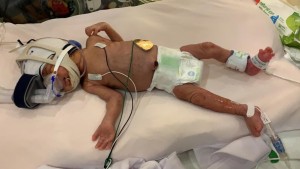
Ayva was small enough to fit in the palm of her father, Brock’s, hand, but she entered the world fighting. Sonya, still heavily medicated and weak from the delivery, only caught a brief glimpse of Ayva before she was rushed to Texas Children’s Neonatal Intensive Care Unit.
“I remember opening my eyes, seeing her, and thinking how tiny she was,” Sonya said.
For days, Sonya was too unstable to even visit Ayva in the NICU. When she was finally wheeled to her daughter’s side, she encountered a scene no parent is ever prepared for — her tiny baby supported by tubes, monitors, and machines.
That moment was overwhelming in every sense, and in the middle of it, Sonya suffered a seizure at her daughter’s bedside. While Ayva was cared for by the expert NICU team, Sonya herself was supported and closely monitored by her care team at the Pavilion for Women. Their compassion and vigilance helped Sonya recover, and after five days, she was discharged and reunited with her family.
And still, the journey was only beginning.
Life Inside the NICU
For three and a half months, the NICU became home to the Blys.
Sonya and Brock visited in shifts, with one of them always by Ayva’s side, asking the medical team questions, learning, and hoping. Every ounce Ayva gained, and every small improvement, was a milestone worth celebrating. Every setback required resilience.
Ayva’s lungs were not fully developed, and she relied on breathing support for nearly her entire NICU stay. Feeding was another challenge. Learning to coordinate swallowing and breathing took time, patience, and constant support.
“There were setbacks,” Sonya said. “But NICU babies are fighters, and Ayva fought through it.”
Through it all, the care team at Texas Children’s became more than clinicians. They were teachers, guides, and a steady source of reassurance in an uncertain time.
“They taught us everything — how to feed her, how to hold her, what to watch for,” Sonya recalled. “They made us feel like we could actually do this.”
From CPR training to everyday care techniques, the NICU team prepared Sonya and Brock to take Ayva home and to care for her with confidence.

Compassion at Every Turn
What surprised Sonya most wasn’t just the clinical excellence she and her family experienced at Texas Children’s. It was the humanity. Despite months in a hospital setting, the experience felt personal and deeply supportive.
“Everybody was incredible,” she said. “The nurses, the doctors, even the valet staff. It didn’t feel like a hospital; it felt like a community.”
She remembers the small moments: staff helping with everyday challenges, volunteers comforting babies whose parents couldn’t be there, and the thoughtful resources designed to ease families’ burdens.
“There was so much thought in everything they did,” she said. “It shows in the care and in how they support families.”
A Fighter Goes Home
After three and a half months, Ayva was finally ready to go home.
Despite early concerns, she left the hospital without the need for oxygen or long-term medical equipment, a milestone her family once wasn’t sure would be possible.
Today, Ayva is seven years old and thriving. She is creative, curious, full of personality, and confidently embraces the role of big sister to her five-year-old brother, Zayn. She loves arts and crafts and views the world with imagination and joy.
There are small reminders of her early journey, subtle developmental differences that are far outweighed by her progress and resilience.
“We were some of the lucky ones,” Sonya reflected.
Gratitude That Lasts a Lifetime
Sonya describes her family’s NICU journey with a mix of awe and gratitude.
“If something like this ever happens, the best place you can be is at Texas Children’s,” she said.

From the first emergency transfer to the day Ayva came home, Sonya says the care her family received made possible the healthy, thriving life they enjoy today. And the Blys are proud to give back in return. For the third consecutive year, they are among the many generous families, individuals, and corporations whose sponsorship of the Bad Pants Open provides vital programs and assistance to NICU families.
From Angel Eye cameras that keep families connected, to the Hand to Hold program that offers comfort and support, to practical resources like assistance with parking, meals, and daily necessities, Bad Pants Open proceeds help turn overwhelming moments into moments of hope and progress.
“When you’re in the NICU, it’s the little things that make the biggest difference,” Sonya concluded. “And those are the things that help families keep going.”
Click here to learn more about supporting NICU families and about the Bad Pants Open.
Related Stories

Patient Stories
Jul 28, 2026
One Step at a Time: Kinsley’s Journey Through Texas Children’s Inpatient Rehabilitation Unit

Patient Stories
Jun 19, 2026
On World Sickle Cell Day, Saniya’s Story Highlights Strength, Community and Compassionate Care


83351
Patient Stories
article