One Step at a Time: Kinsley’s Journey Through Texas Children’s Inpatient Rehabilitation Unit
Patient Stories


How Texas Children’s Inpatient Rehabilitation Unit helped one patient reclaim her life
At 4 years old, Kinsley’s life changed in the span of a few seconds.
She had spent the day outside playing with her little sister. That evening, sitting down for dinner with her family, she dropped her fork. Her dad picked it up and handed it back. She dropped it again.
Then, suddenly, she couldn’t use her hand at all.
“That’s when I realized she was having a stroke,” her dad, William, recalled.
Eventually, Kinsley was rushed from her local hospital in Lake Charles, Louisiana, to Texas Children’s, where doctors discovered a rare and complex condition: abnormal blood vessels had spread across one side of Kinsley’s brain, disrupting blood flow and putting her at risk for strokes, seizures and loss of function.
It was the beginning of a journey that would require Kinsley to relearn how to do almost everything.
After her initial diagnosis, Kinsley continued to experience strokes and transient ischemic attacks. She underwent surgery to improve blood flow, but on her fifth birthday, she suffered a major stroke.
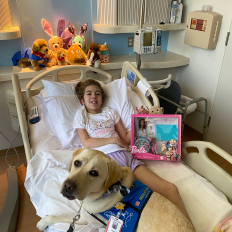
She woke up in the hospital unable to walk, unable to use her arm and struggling to speak. Simple, everyday tasks — eating, moving, communicating — had to be relearned. Even in the ICU, however, there were moments of encouragement and connection that helped set her recovery in motion. Her nurses celebrated her birthday with cake and balloons. And when Elsa, the therapy dog, came to visit, it became something more than excitement — it gave her a reason to try.
“She actually started using her hand to pet Elsa,” her mom, Jade, remembered. “That was the goal. Then they said, ‘Let’s try walking.’”
That next step began at Texas Children’s Inpatient Rehabilitation Unit (IRU). Designed for children who have experienced a significant loss of function due to illness or injury, the IRU provides around-the-clock care in a highly specialized setting. Children receive hours of therapy each day — physical, occupational and speech — while an interdisciplinary team supports their cognitive, developmental and emotional needs as well. Just as important, the focus extends beyond the hospital, helping families prepare for a safe return to home, school and everyday life.
Each day, Kinsley’s room would fill up with therapists, nurses and physicians — all working toward the same goal. Over time, they became more than a care team. They became part of her story.
On the IRU, Kinsley began intensive therapy to treat her condition and help her rebuild her independence.
“We were working really hard to get her back as functional as possible,” said Dr. Christian Niedzwecki, Medical Director of Texas Children’s IRU and one of Kinsley’s rehabilitation physicians.
“She went from not being able to move her arm or leg to walking and running again,” William said. “They got her back.”
For years, Kinsley continued to move forward. She managed seizures, attended school and spent time with her siblings on the family’s farm — fishing, helping with animals and living what her parents describe as a “normal, busy life.”
Then, in late 2023, everything changed again.
She began to lose strength. At first, it came in waves. Then it worsened. By early 2024, Kinsley could no longer move from the neck down.
“The only thing she could move was her eyes,” her dad said.
Weeks of testing followed as doctors searched for answers. Her care team identified a critical issue affecting blood flow in her brain. She underwent another surgery to revise her shunt and restore balance.
In the midst of fear, exhaustion and the pain of watching their daughter unable to move or speak, hope returned in a moment no bigger than a whisper.
“She moved her head and said, ‘I can move my head,’” William said.
It was the first sign that recovery was possible again.
Kinsley returned to the Inpatient Rehabilitation Unit for the second time, facing an even more complex recovery.
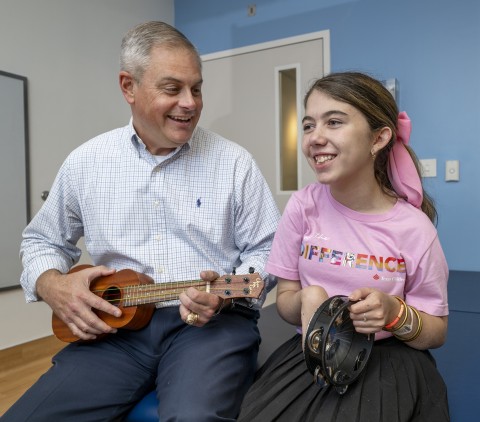
On the IRU, care is built around each child’s needs, goals and life outside the hospital. Patients receive at least three hours of therapy a day, but just as important is the focus on preparing families for what comes next.
“We don’t just treat the child — we treat the family,” Dr. Niedzwecki said. “Everything is focused on how we get them back home.”
For Kinsley, that meant starting from the beginning.
“She couldn’t move anything,” Jade said. “And they worked with her every single day.”
One day, her therapists told her mom that Kinsley had stood up and taken steps.
“I didn’t think she would ever get back to that point,” Jade said.
As Kinsley regained strength, her care team found ways to bring joy into her recovery.
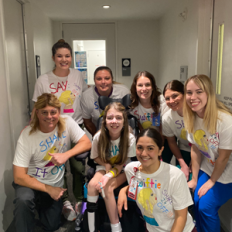
A dedicated Taylor Swift fan, Kinsley used music as part of her speech therapy. That idea turned into something bigger. Together with her therapists and child life specialists, she planned and performed her own Taylor Swift concert on the 16th floor.
She made tickets. Staff members dressed up. And just before discharge, she stood and sang in front of a crowd of caregivers who had watched her journey from a state of near-total paralysis to karaoke and dancing.
“It brought such joy to her,” Dr. Niedzwecki said. “That’s what matters.”
Kinsley’s journey didn’t end there. After a major growth spurt led to severe scoliosis, she underwent spinal surgery in 2025. Within days, she was up and walking again.
Today, at 14, Kinsley is back to doing the things she loves: spending time with her family, being outdoors and living life on her own terms. On most days, she doesn’t need a wheelchair.
“If you didn’t know what she’s been through, you wouldn’t realize it,” William said. “We’re just a normal family.”
“I tell everybody, just come to Texas Children’s Hospital,” he added. “They’re the best. They gave us back our daughter. They actually care — that’s the kind of people they are. We are so grateful.”
Learn more about the Texas Children’s Inpatient Rehab Unit.