Texas Children's Psychosocial Program Team Advances Care Through Recent Publications
Research


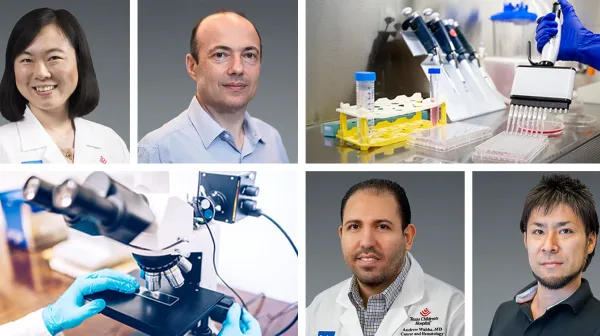
Pictured L-R, by row: Quinn Franklin, Carol Herron, Anastasia Deeter, Mashal Kara, Ashley Matthews, and Michelle Fritsch
The expertise of the Psychosocial Program team at Texas Children’s is helping shape how children and families beyond our Center are supported during and after treatment.
Through recent publications and national collaborations, team members are strengthening psychosocial support for children fighting cancer or serious blood disorders.
These scholarly efforts span a diverse range of focus areas—from creative therapies that enhance the care environment, to educational support programs, to national treatment guidelines that inform decision-making across healthcare systems.
Advancing Arts in Healthcare
Quinn Franklin and Carol Herron co-authored a chapter in the University of Houston’s Innovations in Arts and Health, showcasing the Periwinkle Arts in Medicine Program. They outline how the program is integrated into care delivery, detailing the role of partnerships and art-based activities in supporting patients and families.
The chapter also highlights the benefits of the program, and offer a real-world framework that other healthcare institutions can reference when incorporating their own arts-based programs into clinical care.
Read the chapter here:
Supporting Educational Continuity During Treatment
Michelle Fritsch, Ashley Matthews, Mashal Kara, and Anastasia Deeter developed and evaluated a Back-to-School Screening Program designed to support children as they navigate education during treatment. Their findings were published in Continuity in Education, highlighting both the development of the program and its impact.
Since its launch in 2020, the program has supported more than 1,100 families by systematically identifying school-related needs, facilitating communication between healthcare teams and schools, and connecting families with appropriate resources.
The initiative has helped children maintain educational engagement during treatment and transition more smoothly back to school, while also demonstrating a scalable model for integrating educational advocacy into pediatric psychosocial care.
Read the publication:
https://continuityineducation.org/articles/10.5334/cie.288
Contributing to National Treatment Guidelines
Michelle Fritsch and Anastasia Deeter also contributed to the American Society of Hematology’s (ASH) 2026 guidelines for adolescents and young adults with acute lymphoblastic leukemia. These guidelines are developed by multidisciplinary experts to synthesize current evidence and provide clear, actionable recommendations for both clinicians and patients.
By participating in this work, Michelle and Anastasia helped ensure that psychosocial considerations are represented alongside medical decision-making. The guidelines support more consistent, informed treatment approaches and help clinicians and families navigate complex care decisions across different healthcare settings.
Learn more about Michelle’s Guidelines:
Learn more about Michelle’s Guidelines:
Together, these efforts are helping strengthen how psychosocial care is delivered to children and families facing cancer or serious blood disorders.