
Leave a Legacy Plan for Miracles
The Power of “Yes”
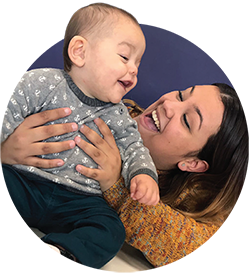
Julian’s Story
Born in Puerto Rico as Hurricane Maria made landfall, Julian Miranda entered the world amid crisis. Shortly after he was delivered by emergency C-section, powerful winds shattered the hospital windows, forcing newborns in the neonatal intensive care unit to be moved into underground tunnels before being transferred to another hospital. For days, Julian’s parents were unable to see him.
Although Julian survived those frightening first days, his family soon faced new uncertaintly. As he grew, his mother, Cynthia, sensed something was wrong. By eight months, Julian was developing more like a much younger infant. After months of searching for answers, genetic testing revealed that he had MECP2 duplication syndrome, an extremely rare neurological condition. Few physicians in Puerto Rico were familiar with the disorder, leaving the family with more questions than answers.
Everything changed in 2020 when the Mirandas attended a conference hosted by the Texas Children’s Duncan Neurological Research Institute and were connected with specialists who understood Julian’s condition and were advancing research to improve the lives of children like him. “That’s when Texas Children’s oered the answer for us,” Cynthia recalls. “It was big for us.”
Encouraged by the expertise and support they found, the family made the decision to move to Texas so Julian could receive care at Texas Children’s. Today, he benefits from a coordinated team of specialists who understand his rare condition and work together to support his health, development, and quality of life. Access to expert care, therapies, and equipment has helped Julian gain strength, improve his mobility, and reach important milestones.
“I have never had a ‘no’ from Texas Children’s,” Cynthia says. “Everything has been a ‘yes.’”
For Dr. Davut Pehlivan, a pediatric neurologist at the Texas Children’s Rett Center, families like Julian’s demonstrate why clinical care and groundbreaking research must go hand in hand. “We are a huge team with the same goal,” he said, “to find a treatment for his condition.”
Julian’s story reflects the power of specialized care, compassionate support, and research-driven hope. “It’s been an amazing experience,” Cynthia says. “It’s been awesome — sometimes breathtaking. At Texas Children’s, my son has the best care, and for me, that is everything.”