
min. read
Study links rare BMPR2 variant to developmental delay and autism and points to a potential path for future treatments
HOUSTON (September 21, 2026) – Research led by Texas Children’s Duncan Neurological Research Institute (Duncan NRI) and Baylor College of Medicine identified a rare genetic change that appears to cause a newly recognized neurodevelopmental disorder. The discovery provides families with a potential explanation for previously undiagnosed developmental challenges and reveals a biological pathway that could guide future treatment research.
The study, published in The American Journal of Human Genetics, describes six unrelated children who carry the same rare change in BMPR2, a gene that helps cells send signals needed for growth and development. Five of the children had global developmental delay affecting movement and speech or language, four were diagnosed with autism spectrum disorder and some experienced seizures, anxiety or hyperactivity.
“Finding the identical genetic change in multiple unrelated children was an important clue, but it did not tell us how the change was affecting brain development,” said corresponding author Dr. Shinya Yamamoto, principal investigator at the Duncan NRI and associate professor in the departments of molecular and human genetics and of neuroscience at Baylor. “By recreating the human variant in fruit flies, we were able to show that it pushes a critical developmental signal into overdrive and produces changes in the nervous system.”
BMPR2 acts like a receiver on the surface of cells. Normally, it responds when a signaling molecule arrives, then helps pass carefully timed instructions into the cell. Those signals are part of the bone morphogenetic protein, or BMP, pathway, which plays important roles throughout the body, including in brain development.
Changes that reduce BMPR2 activity are already known to cause pulmonary arterial hypertension, a serious condition affecting the blood vessels in the lungs. The variant identified in this study works in the opposite way. Instead of weakening the gene’s activity, it makes the BMPR2 receiver overly active—even when the usual signal is absent. Scientists call this a gain-of-function variant.
The research began with genetic data from children with neurodevelopmental conditions. Leveraging the scale of its exome sequencing data and expertly curated clinical information, clinicians at Boston Children’s Hospital, Columbia University and GeneDx identified patients who had the BMPR2 variant of interest and phenotypes similar to the index case. They then helped connect clinicians with the study collaborators, enabling additional patients to contribute to the research and supporting a deeper understanding of the variant and its clinical significance. The team identified the same BMPR2 variant in six unrelated children. In at least five, the change arose spontaneously rather than being inherited from either parent. Because the variant was extremely rare and the children shared overlapping neurodevelopmental features, researchers turned to the fruit fly, a well-established model for studying genes involved in human neurological disease, to test whether the variant was harmful.
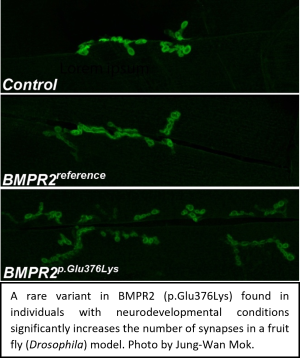
Flies carrying the human BMPR2 variant showed excessive BMP signaling and abnormal nervous system development. When the variant was active in neurons, the flies developed too many connections known as synapses (photo). When it was active in support cells in the brain called glia, it caused a much stronger increase in signaling and severe developmental effects. These findings suggest that several types of brain cells may contribute to the condition.
The team also tested two experimental compounds developed at Baylor College of Medicine’s Center for Drug Discovery. In isolated fly tissues, both compounds reduced the excessive BMP signaling caused by the variant. The results provide early evidence that the overactive pathway can be brought under control, although substantially more research is needed before any treatment could be considered for patients.
“These compounds are research tools, not treatments ready for clinical use,” Yamamoto said. “Still, the ability to reduce the abnormal signal in a living model gives us a starting point for exploring whether this pathway could eventually be targeted safely,” said lead author Dr. Jung-Wan Mok, a postdoctoral fellow in Dr. Yamamoto’s laboratory.
The findings expand scientists’ understanding of BMPR2. They show that different changes in the same gene can lead to very different conditions depending on whether they decrease or increase the gene’s activity. That distinction is important for genetic diagnosis and for determining which therapeutic strategy, if any, might be appropriate.
The researchers note that the study included only six children and relied on fruit flies to investigate the biological mechanism. Future studies in mammalian cells and models will be needed to better understand how the variant affects the developing human brain, identify the brain cells most vulnerable to excessive signaling and evaluate possible treatment approaches.
Other contributors to this work include Carrie L. Welch, Haley A. Dostalik, Zhi Tan, Ariel Brautbar, Maria DesCartes, Erica T. Gray, Alejandro Iglesias, Scott D. McLean, Morgan Nutter, Olivia Daugherty, Amber Begtrup, Ingrid M. Wentzensen, Yufeng Shen, Damian W. Young, Martin M. Matzuk, the Baylor College of Medicine Center for Precision Medicine Models, Oguz Kanca, Michael F. Wangler, Hugo J. Bellen and Wendy K. Chung. The authors are affiliated with one or more of the following institutions: Baylor College of Medicine, Texas Children’s Duncan NRI, Boston Children’s Hospital, Harvard Medical School, Joe DiMaggio Children’s Hospital, Golisano Children’s Hospital, Vanderbilt Health, Columbia University Irving Medical Center and GeneDx.
This work was primarily supported by the National Institutes of Health to the Center for Precision Medicine Models at Baylor College of Medicine, the Intellectual and Developmental Disabilities Research Center at Boston Children’s Hospital and the Autism Center of Excellence at Columbia University. The authors also acknowledge the affected individuals and their families for their participation.
About Texas Children’s
Texas Children's, a nonprofit health care organization, is committed to creating a healthier future for children and women throughout the global community by leading in patient care, education and research. Consistently ranked as the best children's hospital in Texas and among the top in the nation, Texas Children's has garnered widespread recognition for its expertise and breakthroughs in pediatric and women's health. The system includes the Texas Children's Duncan NRI; the Feigin Tower for pediatric research; Texas Children's Pavilion for Women, a comprehensive obstetrics/gynecology facility focusing on high-risk births; Texas Children's Hospital West Campus, a community hospital in suburban West Houston; Texas Children's Hospital The Woodlands, the first hospital devoted to children's care for communities north of Houston and Texas Children's Hospital North Austin, the new state-of-the-art facility providing world-class pediatric and maternal care to Austin families. The organization also created Texas Children's Health Plan, the nation's first HMO focused on children; Texas Children's Pediatrics, the largest pediatric primary care network in the country; Texas Children's Urgent Care clinics that specialize in after-hours care tailored specifically for children; and a global health program that is channeling care to children and women all over the world. Texas Children's Hospital is affiliated with Baylor College of Medicine. For more information, visit www.texaschildrens.org.
Related Stories

News Release
Oct 09, 2026
New genetic candidates help explain why autism affects males more often than females
News Release
Oct 06, 2026
Texas Children’s Dr. Michael Taylor Honored by CPRIT for Advancing Childhood Brain Tumor Research

News Release
Sep 30, 2026
Texas Children’s Pioneers Novel In-Utero Approach for Complex Gastroschisis Through Ongoing Cli...
News Release
Sep 28, 2026
Together human genetics, AI and animal studies provide diagnosis for rare, complex neurodevelopme...

News Release
Sep 14, 2026
Texas Children's Named a Best Children’s Hospital and is Number One in Texas Again for 18th Con...
90566
News Release
article