CARE study reports complete regression of liver cancer in a child treated with novel immunotherapy
News Release


Topics
HOUSTON (Sept. 10, 2026) – A new report in the New England Journal of Medicine by researchers at Texas Children’s, Baylor College of Medicine and Seattle Children’s describes a complete regression of hepatoblastoma, the most common pediatric liver cancer, in a 3-year-old treated with a novel immunotherapy. The patient is enrolled in the CARE study (NCT04715191), a first-in-human, Phase 1 trial evaluating glypican-3-specific chimeric antigen receptor (GPC3-CAR) T cells armed with interleukin-15 and -21 (IL15 and IL21).
The child initially presented with a large primary liver tumor and metastases in the lungs. Prior to enrollment in the CARE study, the patient was treated with three lines of chemotherapy and underwent complete resection of the primary liver tumor and two lung metastases. His cancer was no longer responsive to chemotherapy, and a new lung metastasis recurred after surgery when he was enrolled on the CARE study.
The immunotherapy was engineered from the patient’s own cells at the Good Manufacturing Practices laboratories at the Center for Cell and Gene Therapy using two vectors: one encoding the second-generation GPC3-CAR and the second encoding IL15, IL21 and the inducible caspase 9 safety switch, which Center for Cell and Gene Therapy investigators previously showed controlled CAR T expansion.
Two infusions were administered eight weeks apart in the outpatient setting. A partial response was observed after the first infusion, and imaging showed complete resolution of the metastatic disease after the second infusion. No dose-limiting toxicities or cytokine release syndrome occurred. Complete regression continues one year after treatment.
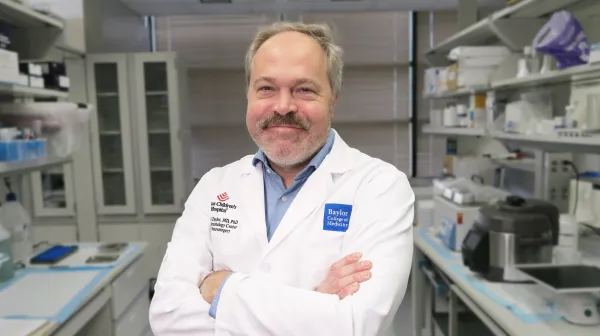
“This case demonstrates that a durable complete response in a chemotherapy-resistant solid tumor can be achieved entirely in the outpatient setting without systemic toxicity,” said first author Dr. David Steffin, associate chief of cellular therapy and bone marrow transplant at Texas Children’s and associate professor of pediatrics – hematology and oncology in the Center for Cell and Gene Therapy at Baylor.
“This study provides evidence that these novel CAR T cells may be a safe and effective modality for hepatoblastoma and highlights the need for further assessment in patients with GPC3+ solid tumors,” said corresponding author Dr. Andras Heczey, principal investigator at Seattle Children’s and professor of pediatrics in hematology-oncology at the University of Washington School of Medicine. Heczey was at Baylor and Texas Children’s at the time of research.
Other authors who contributed to this work include Amy N. Courtney, Michelle Choe, Nisha Ghatwai, Magdalena Abigail Esparza Cerda, Ramy Sweidan, Rajdekar Dhanashree, Huimin Zhang, Natasha Lapteva, Zhuyong Mei, Bambi J. Grilley, Leonid S. Metelitsa, Helen E. Heslop and Malcolm K. Brenner. They are affiliated with one or more of the following institutions: Baylor College of Medicine, Texas Children’s Hospital, Center for Advanced Innate Cell Therapy at Texas Children’s Cancer Center, Center for Cell and Gene Therapy, Dan L Duncan Comprehensive Cancer Center, Seattle Children’s Hospital, and the University of Washington.
See the publication for a full list of funding sources for this work.
About Texas Children’s
Texas Children's, a nonprofit health care organization, is
committed to creating a healthier future for children and women throughout the
global community by leading in patient care, education and research. Consistently ranked as the best children's
hospital in Texas and among the top in the nation, Texas Children's has
garnered widespread recognition for its expertise and breakthroughs in pediatric and women's health. The
system includes the Texas Children's Duncan NRI; the Feigin Tower for pediatric
research; Texas Children's Pavilion for Women, a comprehensive
obstetrics/gynecology facility focusing on high-risk births; Texas Children's
Hospital West Campus, a community hospital in suburban West Houston; Texas
Children's Hospital The Woodlands, the first hospital devoted to children's
care for communities north of Houston and Texas Children's Hospital North
Austin, the new state-of-the-art facility providing world-class pediatric and
maternal care to Austin families. The organization also created Texas
Children's Health Plan, the nation's first HMO focused on children; Texas
Children's Pediatrics, the largest pediatric primary care network in the
country; Texas Children's Urgent Care clinics that specialize in after-hours
care tailored specifically for children; and a global health program that is
channeling care to children and women all over the world. Texas Children's
Hospital is affiliated with Baylor College of Medicine. For more information,
visit www.texaschildrens.org.