How Texas Children’s Is Revolutionizing LCH Care with Precision Medicine and Research
For Physicians


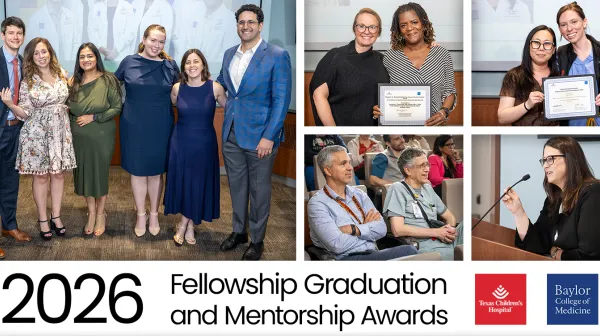
Image depicts members of the Texas Children’s Histiocytosis team (top left panel, L-R): Dr. Nader El-Mallawany, Michelle Nguyen, Wounmee Yaka, Lissette Artie, Kemi Chukwuka-White, Dr. Olive Eckstein, Dr. Zachary Prudowsky, Elizabeth Pacheco, Dr. Carl Allen, Dr. Ken McClain and Yazan Amin. The top right panel shows Dr. McClain and patient, Hadlee.
For decades, Langerhans cell histiocytosis (LCH) has puzzled the medical community with its diverse clinical presentations, ranging from isolated skin lesions to life-threatening, systemic symptoms that mimic acute leukemia, making it difficult to diagnose and treat. Its ambiguous nature — straddling the line between an immune disorder and a cancer — hindered progress in research and treatment. However, thanks to groundbreaking work led by Texas Children’s Cancer and Hematology Center, the confusion surrounding LCH is finally giving way to clarity.
“Historically, LCH was difficult to classify, and that uncertainty created barriers to effective treatment,” said Kenneth McClain, MD, PhD, director of the Histiocytosis Program at Texas Children’s, which is one of the largest in the world, seeing both pediatric and adult patients from five continents. “We now understand it as a neoplastic disorder driven by genetic mutations, a recognition that has reshaped how we approach this disease.”
LCH is a rare disease but has an incidence comparable to pediatric Hodgkin lymphoma. Yet, unlike Hodgkin lymphoma — which has benefited from decades of robust research that helped to significantly improve outcomes — LCH has lagged behind.
Breakthroughs in understanding LCH biology
For those affected, LCH can be an exceptionally frightening and disabling condition. While most patients with localized disease survive, they may experience multiple recurrences and long-term disabilities. High-risk patients with liver, spleen or bone marrow involvement face significant challenges, with the current standard of care curing fewer than 50% of cases. Treatment failure is associated with long-term morbidity, including the risk of associated neurodegeneration.
Until recently, many fundamental questions about LCH biology remained unanswered, largely because systematic studies were scarce. Early clinical trials provided some insights, but they lacked the foundational data needed to develop targeted therapies.
The pivotal shift in understanding LCH began with the discovery of activating mutations in the MAPK pathway. These mutations, particularly in the BRAF gene, clarified that LCH is not merely an inflammatory or immune disorder but a true neoplastic condition. This breakthrough has paved the way for targeted therapies that inhibit these mutations, marking a departure from the historical reliance on empirical chemotherapy.
“We’re now able to identify the genetic abnormalities that drive LCH and develop and test targeted therapies,” said Carl Allen, MD, PhD, co-director of the program.

The program at Texas Children’s Cancer and Hematology Center combines multidisciplinary clinical care and robust research capabilities, with a team of 30+ translational and clinical scientists dedicated to histiocytic disorders, lymphoma and lymphoproliferative disorders. As both a high-volume center — seeing about 120 new patients each year and following over 1,000 others — and the tumor bank for a consortium of LCH clinics, the Center is uniquely positioned to lead these efforts.
“Our high volumes enable us to recognize patterns that might not otherwise be possible to see and enroll nearly all of our patients in clinical trials to test hypotheses and see if ideas generated in the lab result in improved therapies,” Dr. Allen said.
Toward precision medicine
The program’s leadership extends beyond its own walls. In 2014, Texas Children’s partnered with national institutions to form the North American Consortium for Histiocytosis (NACHO). Now, with over 50 members, NACHO provides the infrastructure necessary for multi-center studies. Dr. Allen serves as the consortium’s co-principal investigator and director of the NACHO Biology Center, which is located at Texas Children’s Cancer and Hematology Center.
One notable achievement, in collaboration with The Icahn School of Medicine at Mount Sinai, was the creation of the first preclinical model for LCH. This model is now enabling researchers to test novel therapies and understand disease progression in ways that were previously impossible.
Leveraging its extensive tumor bank, Texas Children’s continues to develop unique cell culture and preclinical models to mimic human LCH. These models, combined with high-throughput drug validation strategies, are enabling researchers to study potential therapies.
“Using siRNA approaches and chemical genomics, we can independently validate candidate genes and pathways,” said Dr. Allen. “This step is crucial for identifying compounds that could serve as both chemical probes and potential lead compounds for drug development.”
Global Reach
Program Scale
Collaborative Impact
“We’re moving from a trial-and-error approach to one grounded in the molecular biology of the disease,” said Dr. McClain. “This transition is giving patients access to therapies designed to arrest the activity of specific mutations, improving outcomes and quality of life.”
This change, which has the potential to transform care, is exemplified by a recent publication from the team and their national collaborators in the journal Blood. The study reveals that, for pediatric LCH, genetic mutations in precursor cells predict clinical risks better than current methods. “This study engaged patients over a 15-year period and leverages advanced imaging and molecular analyses to better tailor treatment to individual patients. It is also highly collaborative, and brings our program together with other national leaders, such as UPMC Children's Hospital of Pittsburgh, and the Icahn School of Medicine at Mount Sinai, to change the paradigm and make a real difference to patients,” adds Dr. McClain.
Next Steps
• Refer a Patient: Submit an online referral form
• Explore Cutting-Edge Care: See Clinical Trials and Novel Therapies at Texas Children’s Cancer and Hematology Center
• Meet Our Team: Texas Children’s Histiocytosis Program