
min. read
Topics
What are the different types of Amplification?
Children with medically uncorrectable hearing loss can use a variety of hearing devices that can make the most of their hearing. The Audiologists at Texas Children’s Hospital can help each child find the most appropriate technology for their condition. No amplification device will “cure” a child’s hearing loss, but when fit appropriately, they should be able to hear much better.
Traditional hearing aids (non-surgical)
Image
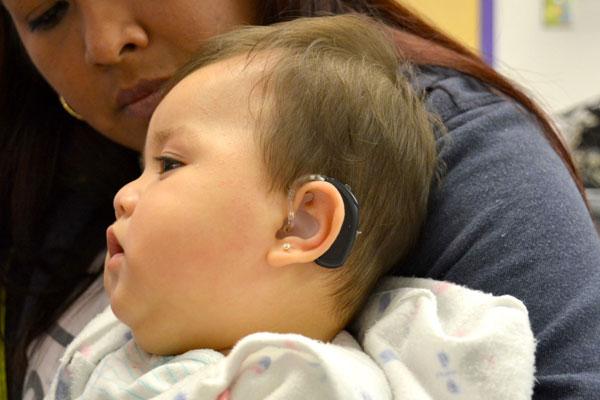
- Make sounds louder
- Sounds still have to travel through the inner ear which is usually the area of impairment
- Hearing aids can help by making sounds louder, but if the hearing loss is very severe, the volume and the quality of the sound may not be enough for adequate language development and communication
- The style of the hearing aid will depend on your child’s age, hearing loss and size of the ear canal. This type of hearing aid is for children who have an outer ear and ear canal
Bone-conduction hearing aid (non-surgical and surgical options)
- Bone-conduction hearing aids transfer sound by vibrations through the bones in the skull to the inner ear
- These devices are designed for people with certain types of hearing loss who cannot benefit from a traditional hearing aid. Your child may benefit from this device if they have:
- Conductive or mixed hearing loss from congenital ear malformations
- Chronic middle ear disease
- Chronic external ear canal infections
- Single-sided deafness
- There are 3 types:
- Osseointegrated/Implanted device (surgical)
- Softband Adaptor (non-surgical)
- Adhesive (non-surgical)
Cochlear implant (surgical)
Image
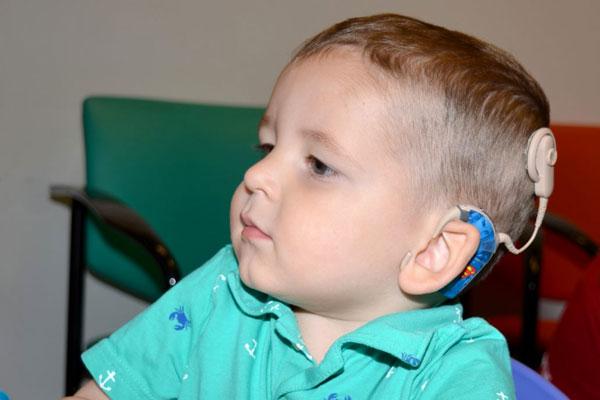
If none of the above devices are an option for your child’s hearing, they may be a candidate for a cochlear implant (CI). The CI works by bypassing the damaged hearing cells within the cochlea and stimulating the auditory nerve directly. Learn more about the Cochlear Implant Program at Texas Children's.
Hearing Assistive Technology (HAT)
These devices allow children to hear speech better in noisy listening environments, such as in a school setting. They work in conjunction with the hearing devices (hearing aids, bone anchored hearing aids and cochlear implants).
24406
Conditions
article