Zekeriyah’s Journey: A Mended Heart
Patient Stories


Zekeriyah is the youngest of triplets, but don’t let that fool you — he’s the leader of the pack. For years, though, his life was shaped by heart episodes that struck without warning. His condition, Wolff-Parkinson-White Syndrome, caused his heart to race dangerously fast during even the simplest activities. His lips would turn blue, his legs would give out, and he’d have to stop playing just to catch his breath.
By the time he was two, Zekeriyah had already learned to perform vagal maneuvers — holding his breath and coughing — to bring his heart back into rhythm. As he grew older, the limitations became harder to ignore. While his brothers excelled on the field, Zekeriyah often sat on the sidelines, hand on his chest, waiting for his heart to calm down.
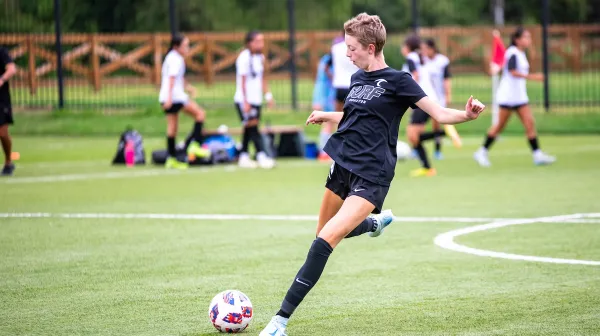
Today, thanks to the cardiac care experts at Texas Children’s Hospital, Zekeriyah’s life is transformed. No longer defined by limitations or fear, he’s now running, playing soccer, and keeping up with his brothers. Living the active, joyful life every child deserves.
I can finally keep up with my brothers.
For most kids, running and playing are second nature. For Zekeriyah, they were a constant source of danger. Diagnosed with Wolff-Parkinson-White Syndrome (WPW) as a baby, he lived with an extra electrical pathway in his heart that caused episodes of rapid heart rate, or tachycardia. Even simple activities could leave him gasping for air, his lips turning blue as his heart raced out of control.
WPW wasn’t his only challenge. Zekeriyah was also diagnosed with Supraventricular Tachycardia (SVT) and AVNRT, conditions that threw off his heart’s rhythm. This meant a childhood filled with physical restrictions, terrifying episodes, and moments of uncertainty.
That’s where Texas Children’s Hospital stepped in. From his diagnosis, the dedicated team at the Heart Center became a source of hope and stability for Zekeriyah and his family. Working tirelessly to manage his condition.
For years, Zekeriyah’s life revolved around managing his condition. Regular cardiology visits, electrophysiology studies, and sleep studies became routine, but his heart condition continued to limit his ability to live like other kids. By the time he was nine, it was clear that surgery was the next step.
Fortunately, he was in the capable hands of Christina Miyake, MD, MS, Director of the Genetics Arrhythmia Program, and the expert cardiac team at Texas Children’s. So after he'd reached the appropriate age and weight — and after the global pandemic had passed — Dr. Miyake performed Zekeriyah's ablation, correcting the extra electrical pathway causing his rapid heart rate.The surgery was a success, and the impact was immediate.
“They always spoke to him directly, not around him," said his mother, Debraeyia. "They empowered him to understand his condition and be part of his care plan."
The ablation did more than stop his heart from racing. For the first time, Zekeriyah could keep up with his brothers without fear. Finally free to be a kid.
I want him to keep doing whatever his heart desires.
Zekeriyah’s journey wasn’t just about overcoming WPW — with Texas Children's he was able to reclaim the moments that make childhood special. From being stuck on the sidelines to sprinting the soccer field, this is what expert care and determination can achieve.
The surgery didn’t just fix his heart — it gave him his childhood back.
For Debraeyia, the transformation is everything she hoped for. “They didn’t just treat his heart,” she said. “They gave him the freedom to live.”
Here, every child’s story is a chance to rewrite what’s possible — and for Zekeriyah, the possibilities are endless.
Thank you, Texas Children's!