Cleft Lip and Palate Center
Defining Clefts
What is a Cleft Lip and Palate?
A cleft lip and/or cleft palate happens when a child’s upper lip, upper gums, and/or palate (roof of the mouth) do not meet while developing in the womb – leaving an open space. It is one of the most common birth conditions in the United States. About 1 out of every 1,000 babies in the United States are born with a cleft. Clefts can be easily repaired with reconstructive surgery.
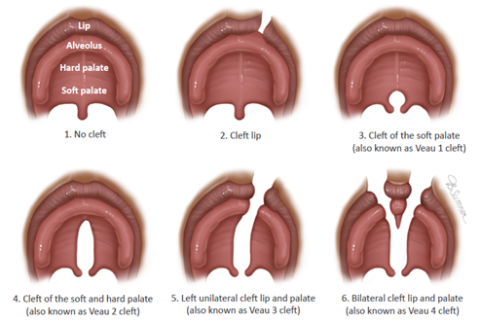
A cleft can impact any combination of these 3 areas:
- Lip: Outside part of the cleft.
- Alveolus: Gum and bone of the upper jaw.
- Palate: The roof of the mouth. There are 2 parts of the palate – the hard palate (bone in the front) and the soft palate (muscles in the back).
What Causes Clefts?
We do not fully understand why clefts occur. In most cases, a cleft spontaneously occurs and is not the result of anything occurring during pregnancy. Sometimes clefts can be related to a family history or genetic condition.
How Clefts are Named
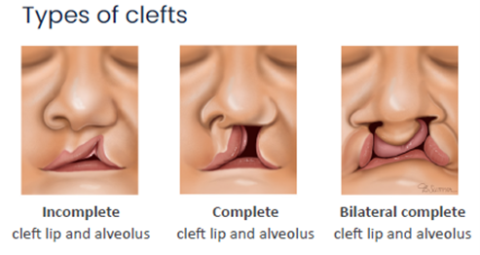
Unilateral – cleft that is only on one side
Bilateral – cleft that impacts both sides
Incomplete – cleft involving a portion of the lip only
Complete – cleft that extends from the lip to the nose