A New Heart, A New Life: Laken’s Journey to Texas Children’s
Patient Stories


Born in Tennessee with hypoplastic left heart, Laken had already undergone two open-heart surgeries when his heart started to fail at 9 months old. Eventually, his doctors placed him on a life support machine and told his parents he was too sick to be a candidate for a heart transplant.
Refusing to give up, his mother, Whitney, reached out to Texas Children’s Hospital. Following a comprehensive review of his brief but complex medical history, Laken’s care transferred to Houston.
“I knew already that Texas Children's is No. 1 in cardiology and has been for years.
So I decided that if we're going somewhere, I want to go to the best place,” said Whitney.
The transfer itself was an urgent and incredibly delicate process. Laken was on ECMO, a form of life support, which required not just a medical team, but an entire logistical operation to move him and the machine safely. The journey, which was fast-tracked from a conversation on Friday to a Monday transfer, was fraught with risk, as his critical access ports were vulnerable to turbulence during the flight.
Luckily, he landed safely in Houston and a Texas Children’s medical team met him upon arrival through the Texas Children's Kangaroo Crew® ambulance service. The Kangaroo Crew focuses on safety and speed to transfer children in times of illness, using a modern fleet of ground and air transportation. Their vehicles function as mobile intensive care units, equipped with specialized portable gear, including ECMO transport capabilities. With this level of expertise to support him, Laken arrived at the hospital ready to prepare for transplant.
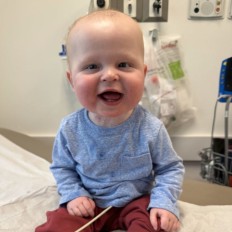
Once Laken arrived at Texas Children’s, the proactive approach of the medical team immediately stood out. The care was never a matter of “let’s just wait and see,” but one of constant optimization. The team spent 3 months working tirelessly to improve his health so that he would be strong enough to withstand a heart transplant.
“The only way I know how to describe it is they were proactive in every decision that they made,” said Whitney.
Doctors from many specialties worked together to address the way his failing heart had affected his lungs and his repeated antibiotic-resistant infections. He was presented to the medical review board 3 times over the course of 3 months before he was accepted to be placed on the transplant list. The family was blessed with a heart after only 33 days, much less than the estimated 6- to 9-month wait.
“Waiting 33 days, if you're familiar with pediatric transplant in any way, that's very unheard of. It’s a very special God-influenced thing to me because the longer that he was waiting in the hospital with these lines, the more chance that he was going to get another antibiotic-resistant bacterial infection,” said Whitney.
Laken received his new heart in October, and after almost 2 months of recovery, he was discharged in early December. Although the team suggested the family stay in Houston for at least 3 months post-transplant, they decided to extend their stay until the following June so that Laken’s older brother could finish school in Houston before moving back to Tennessee.
Extra time provided much-needed stability for Laken and his family as they adjusted to a period of intense care management — juggling over a dozen medications, weaning Laken off certain drugs and attending many therapy and specialist appointments. By staying in Houston, the family was able to focus entirely on managing his complex health needs during this critical transition period.
“It worked out so well because that first 6 months we were juggling a lot. We were weaning medications and going to therapy appointments and visiting every specialist that we saw in the hospital and over the course of 6 months, that kind of falls off,” said Whitney.
Now 2½ years old, Laken is thriving. His speech is improving and his family expects that he will start walking this year. One of his biggest accomplishments is transitioning from being fed exclusively from a feeding tube for most of his early life to eating and drinking by mouth.
“My husband and I just laugh at him because he’s so wild. He's loud. He throws things, and it’s such a unique experience to get to see him live his life now, knowing everything that he’s been through,” said Whitney.
An organ donor can save up to eight lives. To learn more and become a donor, visit Donate Life Texas or Life Gift.
Or, learn more about pediatric heart transplant at Texas Children’s.